
What to Do With an Unused Chimney: Seal, Cap or Remove
A chimney you never use doesn’t stop aging. It still catches rain, wind and animals. Here’s how to decide between maintaining it, closing it off, or taking it down.
Sunday to Friday
An unused chimney should be either properly closed off or removed, not just ignored. For most homes the practical choice is a cap on top, a closed or top-sealing damper, and basic masonry upkeep so it doesn’t leak. If the chimney is in poor shape and you’ll never use it, removing it above the roofline and patching the roof can end the upkeep for good, but first confirm that no furnace or water heater still vents into it.
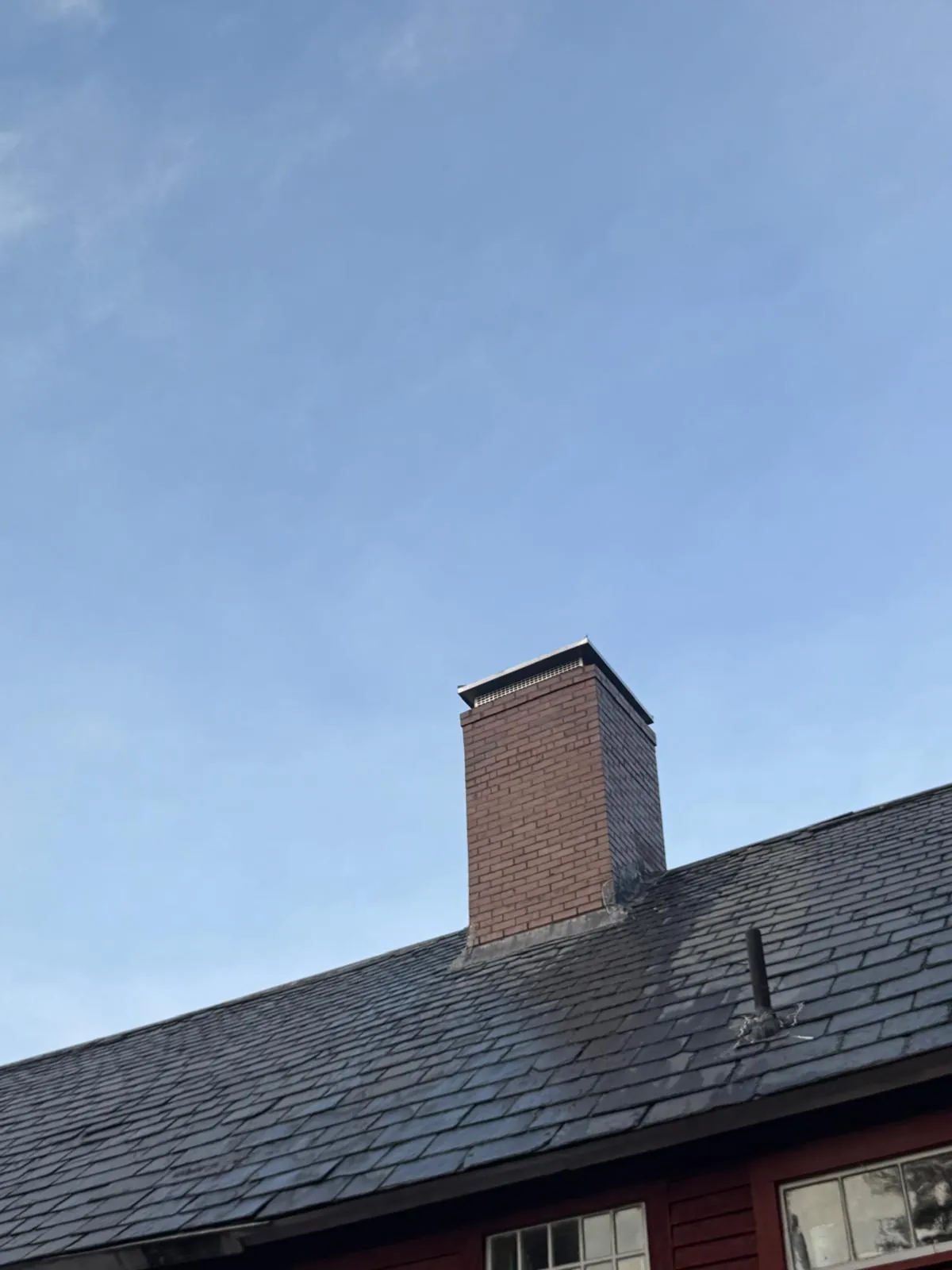
Many chimneys that look retired still vent a boiler, furnace or water heater in the basement. Sealing or removing a flue that’s still in use can send exhaust, including carbon monoxide, into the house. Check every appliance connection before anything is closed off; an inspection confirms what each flue serves.
Why an unused chimney still needs attention
Once the fireplace goes cold, the chimney stops getting the heat that helps dry it out, and nobody looks at it anymore. Rain and snow fall straight down an open flue, soak the smoke chamber and rust the damper. Freeze-thaw cycles keep working on the crown and the mortar at the top, just as they would on a chimney in daily use.
Open flues also invite birds and animals, let warm air escape all winter, and let cold air and musty smells drift back in through the fireplace. And a loose chimney top is a hazard to the roof and to anyone below it, whether or not you ever light a fire.
Your options compared
Ballpark Connecticut ranges for 2026. Treat them as a guide only; your firm price is put in writing after a $59 on-site inspection.
| Option | What it does | Ballpark |
|---|---|---|
| Stainless chimney cap | Keeps rain, birds and animals out while letting the flue breathe | $150–$600 |
| Top-sealing damper | Closes the flue at the top to stop drafts and heat loss; can be reopened if you use the fireplace again | $400–$900 |
| Chase cover (prefab chimney) | Replaces a rusted cover on a sided chase | $400–$1,200 |
| Crown repair | Stops water entering through a cracked top | $200–$1,200 |
| Waterproofing | Vapor-permeable repellent that limits water soaking into the brick | $300–$800 |
| Removal above the roof | Takes the chimney down below the roofline and patches the roof | $1,500–$5,000+ |
Ballpark price check
Typical Connecticut ranges for common chimney jobs.
Closing it off the right way
Closing off an unused chimney has two ends. At the top, a chimney cap keeps weather and animals out; a top-sealing damper goes further and stops air movement, which helps with drafts and heat loss. At the bottom, keep the fireplace damper shut, or have a broken one fixed through damper repair, and consider blocking the opening from the room side with a removable panel or an inflatable draft stopper.
One caution: masonry that is sealed tight with no path for moisture to escape can stay damp inside. Most unused chimneys do better with some ventilation, which is why a vented cap is the usual choice for a flue that won’t be used. Talk through ventilation for your chimney before you seal both ends.
Whatever you choose, label the fireplace clearly so nobody lights a fire in a closed-off flue, and remove any draft stopper before a fire if the chimney is ever brought back into use.
When removal makes more sense
Removing a chimney is worth considering when it’s unused, in poor shape above the roof, and would need a partial rebuild to stay safe. A partial rebuild runs about $3,000–$8,000 as a ballpark, and rebuilding a chimney that has no job to do is hard to justify.
The most common approach is taking the chimney down below the roofline, framing and decking over the opening, and roofing it in to match. The part inside the house stays in place, closed off, and no longer faces the weather. Taking a chimney out all the way through the living space is a much larger structural project and rarely necessary.
Keep in mind that removal is hard to undo. If you might want a fireplace or wood stove someday, or the chimney is a defining feature of an older or historic home, repairing and capping it is usually the better call. Our chimney removal page covers the process in detail.
If the unused chimney is a prefab
Not every chimney is brick. Many homes from the 1970s on have a factory-built fireplace vented through a metal pipe inside a wood- or vinyl-sided box called a chase. When that fireplace sits unused, the weak point is usually the metal chase cover on top: it rusts, holds puddles, and eventually lets water run down inside the chase and into the walls.
Closing off an unused prefab works differently from masonry. A new stainless chase cover with a cap, priced at roughly $400–$1,200 as a ballpark, keeps the chase dry, and the fireplace itself can be left closed. Our page on prefab chimney and chase repair explains what to look for.
Decision guide: keep, close off or remove?
Run through these questions before deciding. The answers usually make the choice obvious.
- Does any appliance still vent into any flue? If yes, that flue is in use and must stay open and maintained.
- Might you want a fireplace, stove or insert in the future? If so, keep the chimney and maintain it.
- Is the chimney top sound, or would it need a partial rebuild to stay safe?
- Is there a leak, staining or an animal problem right now?
- Is the home in a local historic district, or is the chimney part of the house’s character?
- Are you replacing the roof soon? Removal, or new flashing, is easiest while the roof is open.
- How much warm air are you losing through the fireplace in winter?
How A Class helps you settle it
Give us a call at (203) 779-6787 and tell us what the chimney used to serve and what’s bothering you about it now: a leak, a draft, animals, or simply the question of what to do with it. We’ll come out for a $59 inspection visit, trace which flues are still connected, photograph the top, and check the crown and masonry.
Then we lay out the options that make sense for your house, each priced in writing, so you can weigh capping and repairing against removal on real numbers rather than guesses. Whatever you pick, the work area is protected and cleaned up when the job is done.
Prefer we call you?
Three quick taps and a real person from A Class Chimney calls you back to set up a $59 on-site inspection.
- $59 on-site visit and written estimate
- Photos of everything we find
- A written price before any work starts
- Licensed and insured in Connecticut
Sunday to Friday
What do you need?
When?
Where should we call you?
Free, no obligation. Privacy
Common questions
Have us take a look
$59 on-site visit, photos of what we find and a written price before any work. Licensed and insured in Connecticut.