
Prefab Chimney & Chase Cover Repair in CT
If your chimney is a sided box with a metal top, it is a factory-built system. Its weak point is usually the chase cover, and the warning signs are easy to spot from the yard.
Sunday to Friday
A prefab chimney is a metal flue pipe inside a wood-framed, sided box called a chase, topped by a metal chase cover. The most common trouble spot is that cover: once it rusts or sags, it holds water and drips into the chase and the fireplace. Replacing it with a stainless cover runs about $400–$1,200 in Connecticut as a 2026 ballpark, with the exact price set in writing after a $59 on-site inspection.
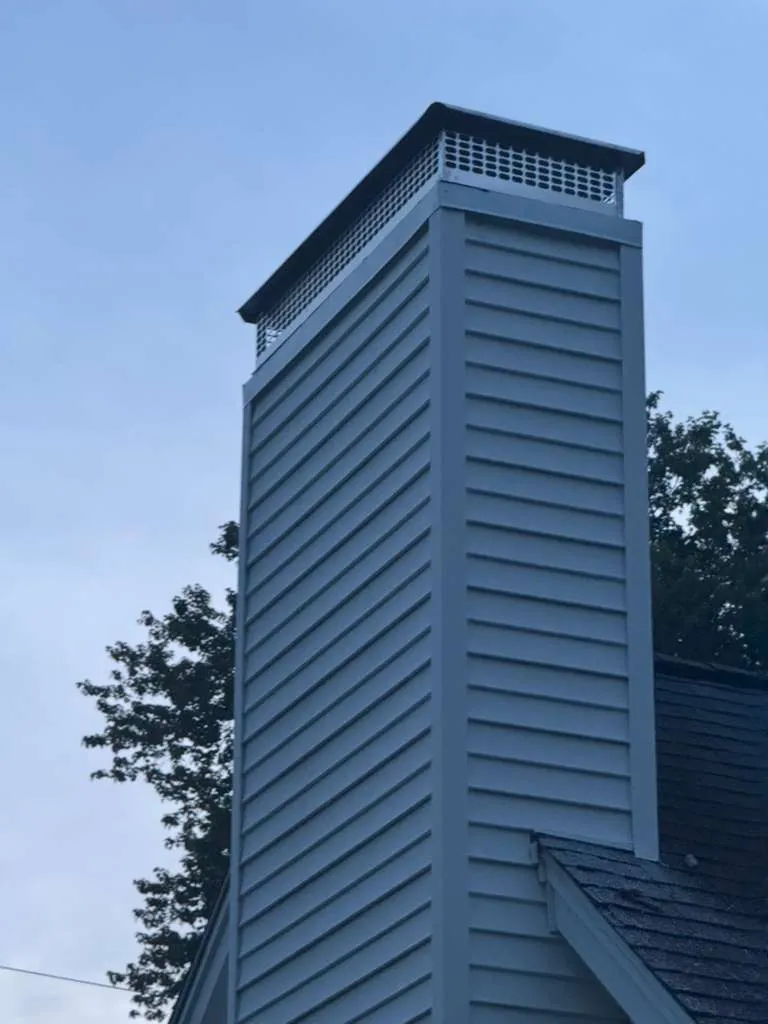
How to tell if you have a prefab chimney
From outside, a prefab chimney usually looks like a box covered in the same siding as the house, sometimes with a brick or stone veneer, with a flat metal pan and a cap on top. Inside, the fireplace is a metal unit lined with refractory panels rather than firebrick, often with a metal grille or vents above or below the opening.
Factory-built fireplaces became common in the 1970s and later, so you find them in many Connecticut subdivisions, condominiums and additions put on older houses. They are a different animal from a masonry chimney, and they fail in different ways.
They are also tested and listed as a complete system. That matters for repairs: the chimney pipe, firestops, cover and cap are designed to work together, so repairs should use components compatible with that system rather than whatever is at hand.
Where prefab chimneys fail
Rusted chase cover
Many original covers are thin galvanized steel. Once the coating wears, rust spreads, the pan sags, and water pools in the middle and drips into the chase.
Rust streaks on the siding
Orange or brown streaks running down from the top are the most visible sign that the cover is rusting through.
Water in the firebox
Rust spots on the fireplace floor, or dripping during storms, often trace back to the cover or the storm collar around the flue pipe.
Rotted chase framing
Water that runs into the chase for years can rot the sheathing and framing around the flue, out of sight until siding starts to bulge.
Cracked refractory panels
The panels lining the firebox crack with heat and age, and badly broken ones expose the metal behind them. See firebox repair.
Animals in the chase
Gaps around a rusted cover or a missing cap let birds and squirrels in. Read about getting animals out of a chimney.
Leak locator
Pick where the water shows up to see the likely sources.
Check your prefab chimney from the ground
Five minutes in the yard and at the fireplace tells you a lot. All of it can be done without a ladder.
- Orange or brown streaks on the chase siding below the top.
- A top edge that looks wavy or sagging when you sight along it.
- Siding on the chase that is swollen, buckled or has opened at the seams.
- Rust flakes, water or stains on the fireplace floor after rain.
- A musty or damp smell from the fireplace in humid weather; see chimney odors.
- Cracks in the firebox panels that go deeper than surface lines, or pieces missing.
- Nesting material, scratching or chirping in the chase.
- No record of the chimney being inspected since you bought the house.
What you see, and what usually fixes it
Match the symptom to the likely fix. Ballpark ranges are Connecticut 2026 figures; the firm figure is written up once the chimney has been seen.
| What you see | Likely cause | Usual fix and ballpark |
|---|---|---|
| Light surface rust, cover still flat and solid | Coating starting to wear | Keep an eye on it; have it checked at the yearly inspection |
| Rust streaks on the siding, pan sagging | Cover rusting through and holding water | Stainless chase cover, $400–$1,200 |
| Bent or rusted cap, cover sound | Cap at the end of its life | Stainless cap, $150–$600 |
| Leak at the roofline only | Flashing where the chase meets the roof | Flashing repair, $400–$1,500 |
| Cracked or crumbling firebox panels | Heat cycles and age | Refractory panel replacement, $500–$2,500 |
| Bulging siding or soft spots on the chase | Water inside the chase for a long time | Fix the top first, then plan carpentry from the photos |
Why a stainless chase cover is the fix
A replacement cover is made to fit the chase. Stainless steel does not rust the way galvanized steel does, and a well-made cover is formed with a slight slope or cross-break so water runs off instead of pooling, plus a drip edge that throws water clear of the siding rather than letting it run down the face.
Connecticut’s nor’easters drive rain sideways for hours, so the details at the edges matter as much as the metal. The cover has to overlap the top of the siding, and the storm collar and cap have to be sealed around the flue pipe, so that the whole top sheds water from every direction.
Chase cover replacement runs about $400–$1,200 as a ballpark, depending on the size of the chase and the roof access. A stainless cap on its own runs $150–$600. The firm price for your chimney is written up after the $59 inspection visit.
What we do, and do not do, on a factory-built fireplace
On prefab systems, A Class inspects and cleans the chimney, replaces chase covers and caps, repairs flashing and leaks where the chase meets the roof, and replaces cracked refractory panels in the firebox with panels made for that unit.
We do not sell or install fireplaces, inserts or stoves. If the metal firebox itself is warped or burned through, or the unit has reached the end of its life, replacing it is an appliance job, and we will tell you plainly that this is what we found rather than patch around it. Gas valves, gas lines and gas log sets belong to a licensed gas technician.
If years of water have rotted the framing or sheathing inside the chase, we photograph it and show you, so the carpentry can be planned before a new cover goes on top of it.
How a chase repair goes with A Class
- Call or ask for a callbackTell us what you have noticed, such as rust streaks, a leak into the firebox or a draft, and roughly when the house or addition was built.
- Free look with drone photosThe tech photographs the cover, cap and flashing from above and checks the firebox and flue from inside, so you see every problem for yourself.
- Measured, written priceThe chase is measured for a new cover, and you get a written price before anything is ordered.
- Install and clean upThe old cover comes off, the new stainless cover and cap go on and are sealed, and the work area is cleaned up inside and out.
A factory-built fireplace is tested for specific fuels and clearances. Do not burn in it with broken panels, a missing grille or a damaged firebox, and follow the manufacturer’s manual for what it can burn. If smoke ever fills the house or a CO alarm sounds, get everyone out and call 911.
Prefer we call you?
Three quick taps and a real person from A Class Chimney calls you back to set up a $59 on-site inspection.
- $59 on-site visit and written estimate
- Photos of everything we find
- A written price before any work starts
- Licensed and insured in Connecticut
Sunday to Friday
What do you need?
When?
Where should we call you?
Free, no obligation. Privacy
Common questions
Related guides and services
Have us take a look
$59 on-site visit, photos of what we find and a written price before any work. Licensed and insured in Connecticut.