
Spalling Chimney Brick Repair & Replacement in CT
Flakes of brick on the roof, in the gutter or on the patio mean water is freezing inside your chimney. Here is how to judge how far it has gone and what fixing it involves.
Sunday to Friday
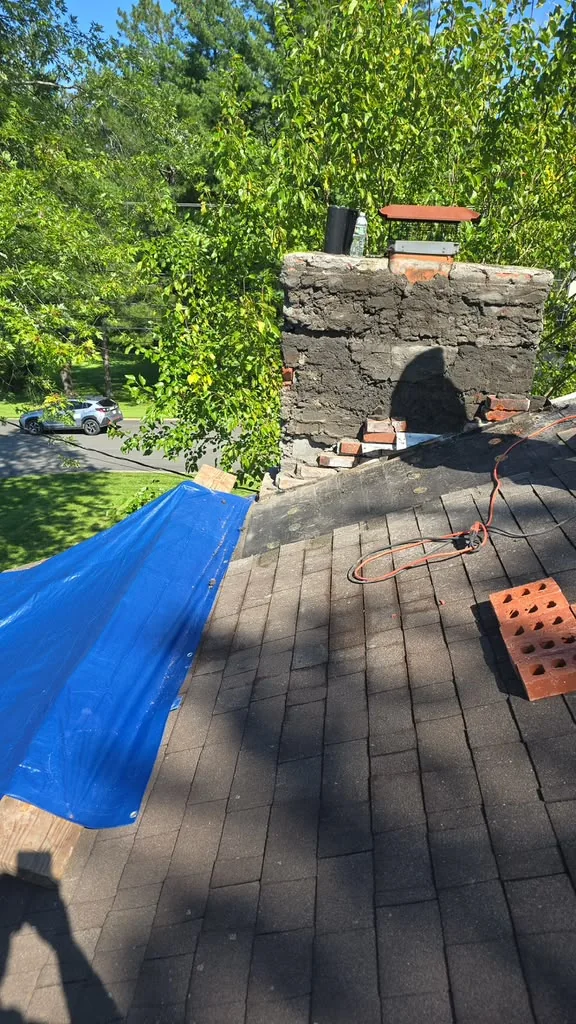
Spalling is when the face of a brick flakes, pops off or crumbles because water absorbed into it freezes and expands. The fix is to cut out and replace the damaged bricks and stop the water that caused it, usually at the crown, cap or mortar joints. In Connecticut, spalled brick replacement runs about $500–$2,500 as a 2026 ballpark, depending on how many bricks are involved.
What spalling is and why Connecticut chimneys get it
A brick is full of tiny pores. When rain soaks in and the temperature drops below freezing, the water turns to ice and expands, pushing outward on the surface. Connecticut swings above and below freezing many times in a typical winter, and every cycle loosens the face a little more until it shears off in flakes, coin-sized chips or whole slabs.
Chimneys take the worst of it because they stand above the roof with no overhang to shelter them, wet on every side and cold on the outside even when the flue is warm. The courses just under the crown usually go first, along with the side that faces the worst storms.
Spalling is easy to dismiss as cosmetic, but it is a symptom. A brick that has lost its hard outer face soaks up water even faster than before, so the damage accelerates each winter once it starts. Catching it while it is a handful of bricks is what keeps it a repair rather than a rebuild.
What makes some chimneys spall faster than others
Every chimney in the state sees freeze–thaw. These are the conditions that make one chimney spall within a few winters while the one next door stays sound.
Water from the top
A cracked crown or a missing cap lets water soak the upper courses from inside the chimney, where it cannot dry quickly. Our cap vs. crown explainer shows how each one protects the brick.
Hard mortar on soft brick
Older brick was meant to be laid in softer lime mortar. Repointing it with hard modern mortar forces moisture to leave through the brick instead of the joints, and the brick faces fail.
Paint or the wrong sealer
A coating that does not breathe traps moisture behind it. That water freezes and lifts the face of the brick, often taking the coating with it.
Brick not made for exposure
Some old chimneys, and some past repairs, used softer brick that was never meant to stand fully exposed to the weather.
Moisture from the inside
In an unlined or poorly lined flue, exhaust from an oil or gas appliance can condense inside the masonry and attack the brick from behind. See our oil boiler chimney guide.
Chimney symptom checker
Tick what you have noticed and see what it usually means.
How bad is it? A ground-level check
You can judge a lot from the yard. Use binoculars or your phone’s zoom, and keep your feet on the ground.
- A few bricks with thin flakes missing from the face: early spalling, usually a small replacement job.
- Bricks with deep pits or the face gone entirely, so the rough inner core shows: those bricks need to come out.
- Brick fragments in the gutters, on the roof shingles or on the ground below the chimney.
- Spalling spread across a whole side, or across the top several courses: ask about a partial rebuild as well as spot replacement.
- Recessed or sandy mortar joints next to the damaged bricks.
- White, powdery staining on the brick, a sign of water moving through it.
- Damp spots, peeling paint or stains on walls or ceilings near the chimney indoors.
- Cracked or crumbling brick inside the fireplace is a different problem, caused by heat rather than frost; see firebox repair.
A real partial rebuild, before and after
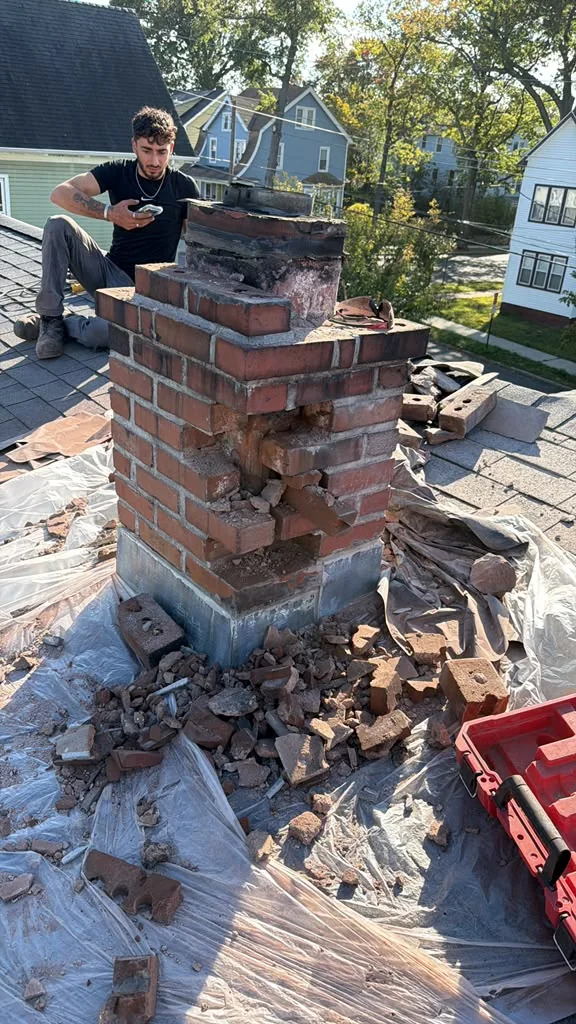
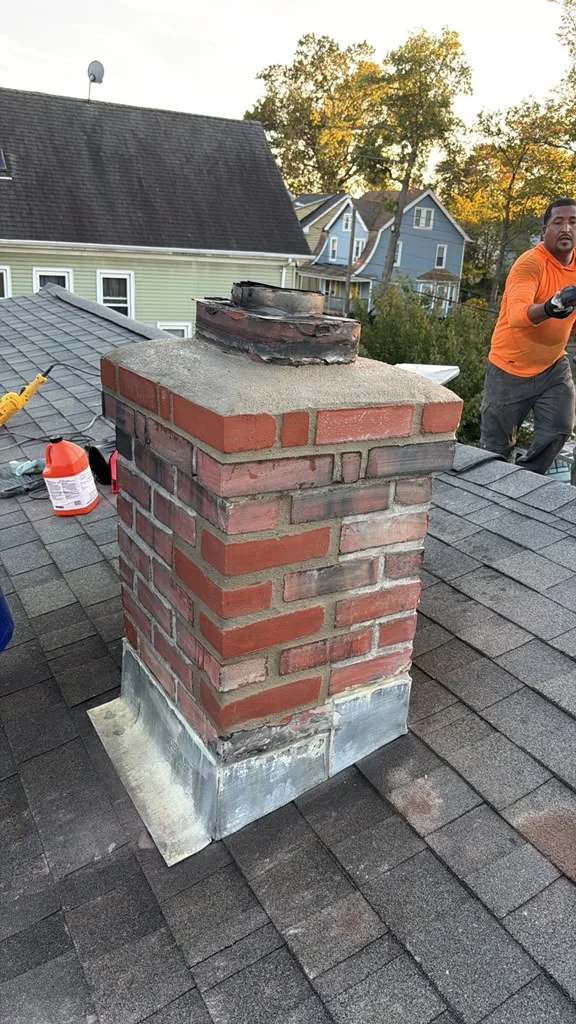
The same chimney, during and after the work. The damaged top courses come down with the roof covered in tarps, then the top is rebuilt and finished with a new crown.
Replace the bricks, or rebuild?
Spot replacement works when the damage is scattered: a handful to a few dozen bricks, with sound brick around them. Damaged bricks are cut out, new brick of matching size and color is set in mortar compatible with the old masonry, and the joints around them are repointed. A well-matched patch blends in more as it weathers.
Once the damage covers most of the top section, or bricks are loose rather than just flaking, replacing them one at a time costs more than it is worth and leaves you with old, saturated brick in between the new ones. That is when rebuilding the top makes more sense. The repair vs. rebuild guide lays out the criteria.
Either way, the repair only lasts if the water source is fixed in the same job, whether that is the crown, the cap, the flashing or the mortar. Afterward, a breathable waterproofing treatment can slow the next round of damage.
Matching brick on older Connecticut homes
Older colonials and Victorians in the Hartford and New Haven areas often have brick in sizes and shades that are no longer standard. Matching it takes some looking, and sometimes reclaimed brick is the closest match. On mid-century capes and ranches the brick is usually easier to source, but the mortar color still needs care.
Ask to see the replacement brick before it goes in. Size matters more than color, because an odd-sized brick forces uneven joints that catch the eye from the street. Mortar should be suited to the age of the brick: softer brick generally calls for a softer, more forgiving mortar, which is something our tuckpointing page covers in more depth.
If the house is in a local historic district, check with the town before work starts, since some districts review changes to visible exterior masonry.
What happens when you call A Class about crumbling brick
Start with a call to (203) 779-6787 or a callback request. A photo from the ground helps us understand what you are seeing. A tech then comes out for a free look, checks the brick, mortar, crown, cap and flashing, and takes drone photos of the top so you can see the damage up close on a screen.
You get a written price that counts the damage honestly: how many bricks, how much repointing, and what has to be done about the water source. Brick replacement typically runs $500–$2,500 as a ballpark, depending mainly on the number of bricks and the height of the chimney, and nothing starts until you approve the written figure. On the day, the area below the chimney is protected, the old brick is cut out and cleared away, the new brick is set to match, and the site is cleaned up.
If chunks of brick are coming off, keep children, pets and cars away from the area under the chimney and leave the fireplace unused until someone has looked at it. Stay off the roof and the ladder; a weakened chimney top can shift under a hand or a ladder.
Prefer we call you?
Three quick taps and a real person from A Class Chimney calls you back to set up a $59 on-site inspection.
- $59 on-site visit and written estimate
- Photos of everything we find
- A written price before any work starts
- Licensed and insured in Connecticut
Sunday to Friday
What do you need?
When?
Where should we call you?
Free, no obligation. Privacy
Common questions
Have us take a look
$59 on-site visit, photos of what we find and a written price before any work. Licensed and insured in Connecticut.