
Chimney Repair vs. Rebuild: How to Decide
Most chimneys can be repaired. Some reach the point where patching is money spent on masonry that keeps failing. Here’s how to tell which side of that line yours is on.
Sunday to Friday
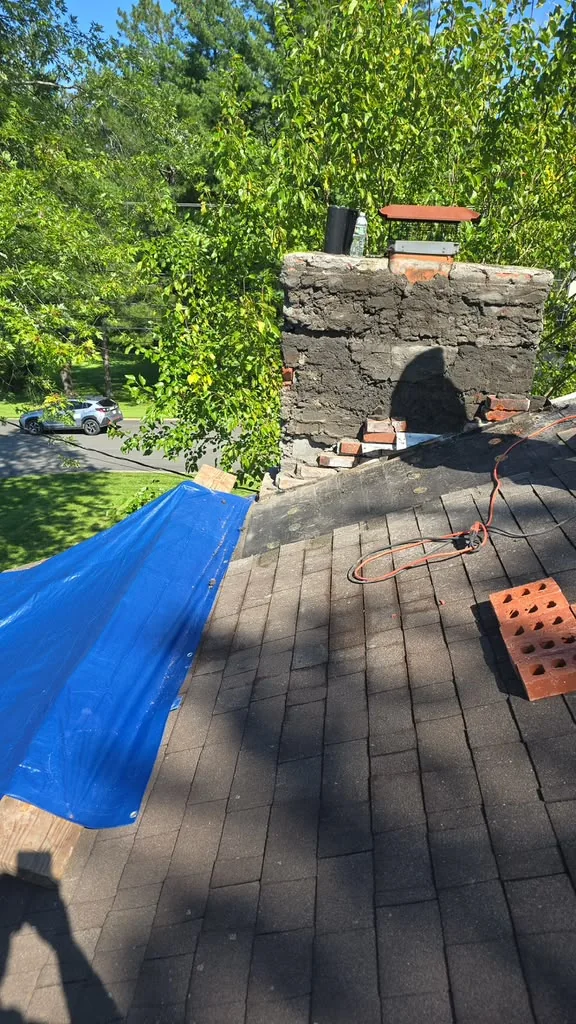
Repair makes sense when the damage is limited: worn mortar joints, a few spalled bricks, a cracked crown or failed flashing on an otherwise solid chimney. A rebuild is usually the better value when bricks are loose rather than just worn, the chimney leans or has pulled away from the house, or damage covers most of the stack above the roof. A close look at the chimney top, with photos, settles it.
The basic difference
A repair keeps the existing structure and fixes parts of it: new mortar in the joints, replacement bricks, a new crown, new flashing. A rebuild takes the chimney down to sound masonry and lays it back up with new brick and mortar.
A partial rebuild usually covers the section above the roofline, which takes the most weather. A full rebuild goes further down, sometimes all the way to the footing.
The real question isn’t which option is better in general. It’s whether the brick and mortar you’d be keeping are still sound enough to hold a repair for many years.
Repair or rebuild: the signs side by side
Match what you or your contractor see on the chimney to the column on the right. These are the patterns that usually decide it.
| What you see | Usually points to | Why |
|---|---|---|
| Recessed or sandy mortar joints, bricks firm | Repair (repointing) | The structure is fine; only the joints have weathered. |
| A few bricks with flaking faces | Repair (brick replacement) | Isolated spalling can be cut out and replaced. |
| Cracked crown on an otherwise solid chimney | Repair (crown) | The crown is a separate slab and can be redone on its own. |
| Top courses shifted, open gaps between bricks | Partial rebuild | Once bricks lose their bond, new mortar in the joints won’t re-anchor them. |
| Spalling across most of the stack above the roof | Partial rebuild | Replacing most bricks one at a time costs more than relaying them. |
| Chimney leaning or separating from the wall | Rebuild, after finding the cause | A lean usually starts below, at the footing or a failed connection, not in the bricks. |
| Damage after a chimney fire | Depends on the inspection | A Level 2 inspection shows whether the liner and masonry survived. |
Ballpark price check
Typical Connecticut ranges for common chimney jobs.
Five questions that settle the decision
When a chimney sits on the line between the two, these questions almost always tip it one way.
- Are the bricks loose or only worn? Worn faces and joints can be repaired. Bricks that move have lost their bond, and that section needs to be relaid.
- How much of the chimney is affected? Damage in a few spots favors repair. Damage spread across most of the stack above the roof favors a partial rebuild.
- Is the chimney still plumb? A lean, or a gap opening up at the siding, means something lower down is moving. Fixing only the top wastes money. Our page on leaning chimney repair covers the causes.
- Has it been patched before, and how recently? Repairs repeated every few years are a sign the masonry underneath has run out of life.
- What else is coming up? If you need a new liner or a new roof soon, rebuilding first avoids tearing into fresh work later.
A real partial rebuild, before and after
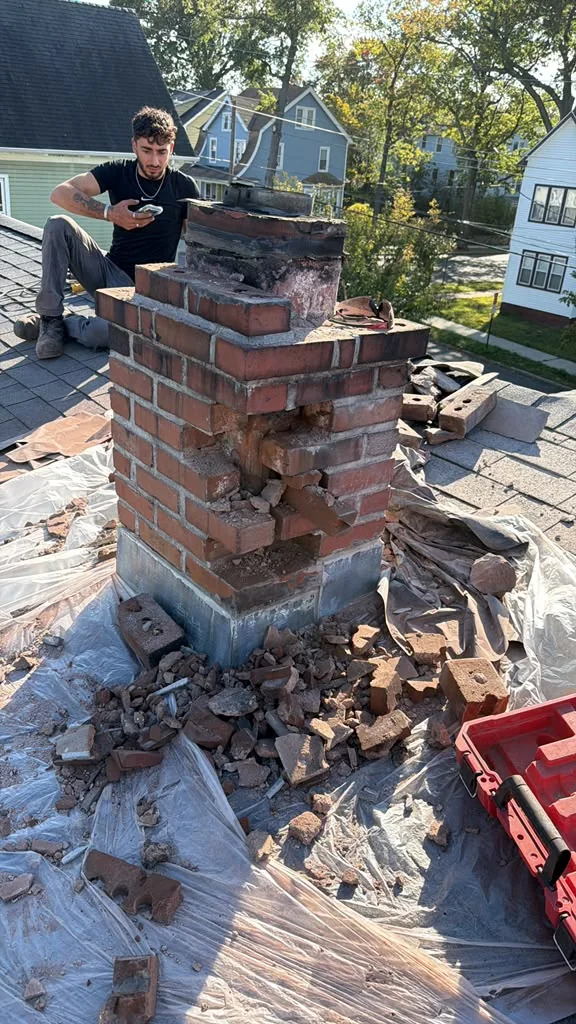
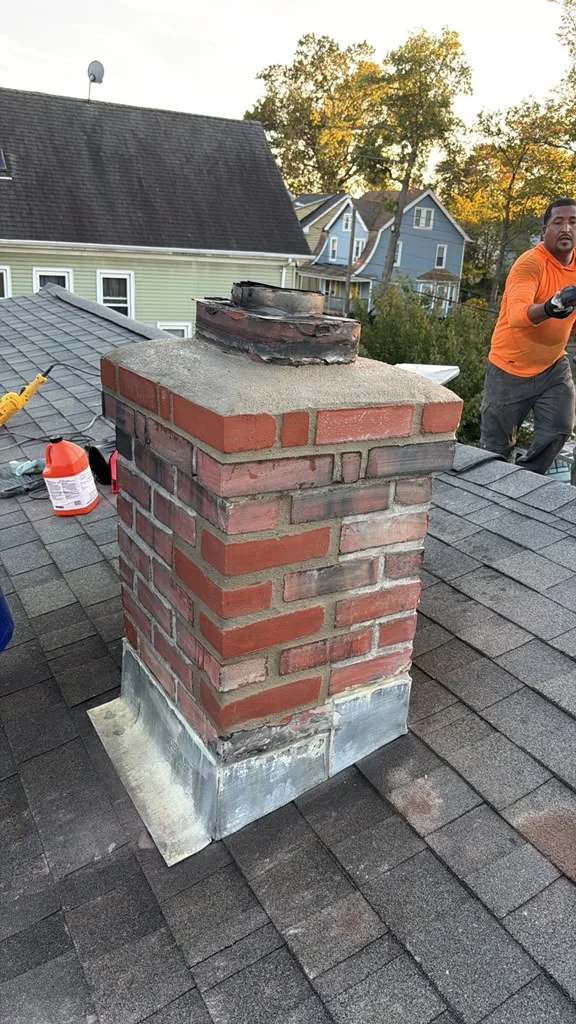
The same chimney, during and after the work. The damaged top courses come down with the roof covered in tarps, then the top is rebuilt and finished with a new crown.
How the costs compare over time
Repairs feel cheaper because each one is. The comparison that matters is what you’ll spend on the chimney over the next couple of decades, not this year alone.
Here are 2026 ballpark ranges for Connecticut. Repointing runs $800–$3,000+, spalled brick replacement $500–$2,500, and crown repair $200–$1,200. A partial rebuild above the roofline is typically $3,000–$8,000, and a full rebuild $8,000–$20,000+. None of these is a quote; the figure for your chimney is set in writing after the $59 on-site inspection.
A simple rule of thumb: if the repairs needed today add up to a large share of a partial-rebuild price, and the masonry will still be old and porous afterward, the rebuild is usually the better value. Our chimney rebuild cost and chimney repair cost guides break the numbers down further.
What a partial rebuild actually involves
It helps to know what you’re buying. On a typical partial rebuild, the chimney is taken down course by course to the point where the brick and mortar are sound again, often a little below the roofline. Old brick that is still solid can sometimes be cleaned and reused; the rest is replaced with brick chosen to match.
The chimney is then laid back up to the correct height with fresh mortar, finished with a new crown that sheds water away from the brick, and topped with a cap. New flashing ties it into the roof. Because the flue is open during the work, it’s also the natural moment to check the liner and fix or reline it if needed.
Done this way, the visible part of the chimney is effectively new, and the problems that drove the decision, like loose courses and saturated brick, leave with the old masonry.
Bricks falling onto the roof or the ground, a chimney visibly leaning, or a crack that keeps widening are safety problems, not cosmetic ones. Keep people and cars away from the area below, stop using the fireplace, and get it looked at promptly. Stay off the roof yourself; photos from the ground are enough to start. See emergency chimney repair for first steps.
Connecticut weather and the repair-or-rebuild question
Freeze-thaw cycles do most of the damage here. Water soaks into porous brick and mortar, freezes, expands, and pushes faces off and joints apart. A chimney top that has been taking on water for years can look acceptable from the yard and still be loose up close.
That’s why keeping water out matters after either path. A sound crown, a stainless chimney cap, good flashing and a breathable water repellent keep the new work from going through the same cycle again.
Getting a second opinion from A Class
- Describe what you’re seeingPhone (203) 779-6787 or use the callback form. Ground-level photos help, and you never need to climb up to take them.
- $59 on-site inspectionWe check the chimney from the roof and from inside, often with a drone for the top, to tell whether the bricks are sound or loose.
- Photos and a straight answerYou see the same photos we do. If a repair will hold, we’ll say so; if a rebuild is the better value, we’ll show you why.
- Written prices to compareWhere both paths are reasonable, ask for each one priced in writing so you can weigh them side by side.
- Clean, careful workDrop cloths, protection for the roof and landscaping, and clean-up when the job is finished.
Prefer we call you?
Three quick taps and a real person from A Class Chimney calls you back to set up a $59 on-site inspection.
- $59 on-site visit and written estimate
- Photos of everything we find
- A written price before any work starts
- Licensed and insured in Connecticut
Sunday to Friday
What do you need?
When?
Where should we call you?
Free, no obligation. Privacy
Common questions
Have us take a look
$59 on-site visit, photos of what we find and a written price before any work. Licensed and insured in Connecticut.