
Chimney Waterproofing in CT: Breathable Brick Protection
A breathable water repellent keeps rain out of chimney brick while letting trapped moisture dry out. Applied after the real leaks are fixed, it is an affordable way to slow freeze–thaw damage.
Sunday to Friday
Chimney waterproofing is a vapor-permeable water repellent applied to the brick and mortar above the roof, so rain beads off while moisture inside the masonry can still escape. In Connecticut it runs about $300–$800 as a 2026 ballpark. It works on sound masonry, after any crown, flashing or mortar problems have been repaired.
Why brick chimneys soak up water
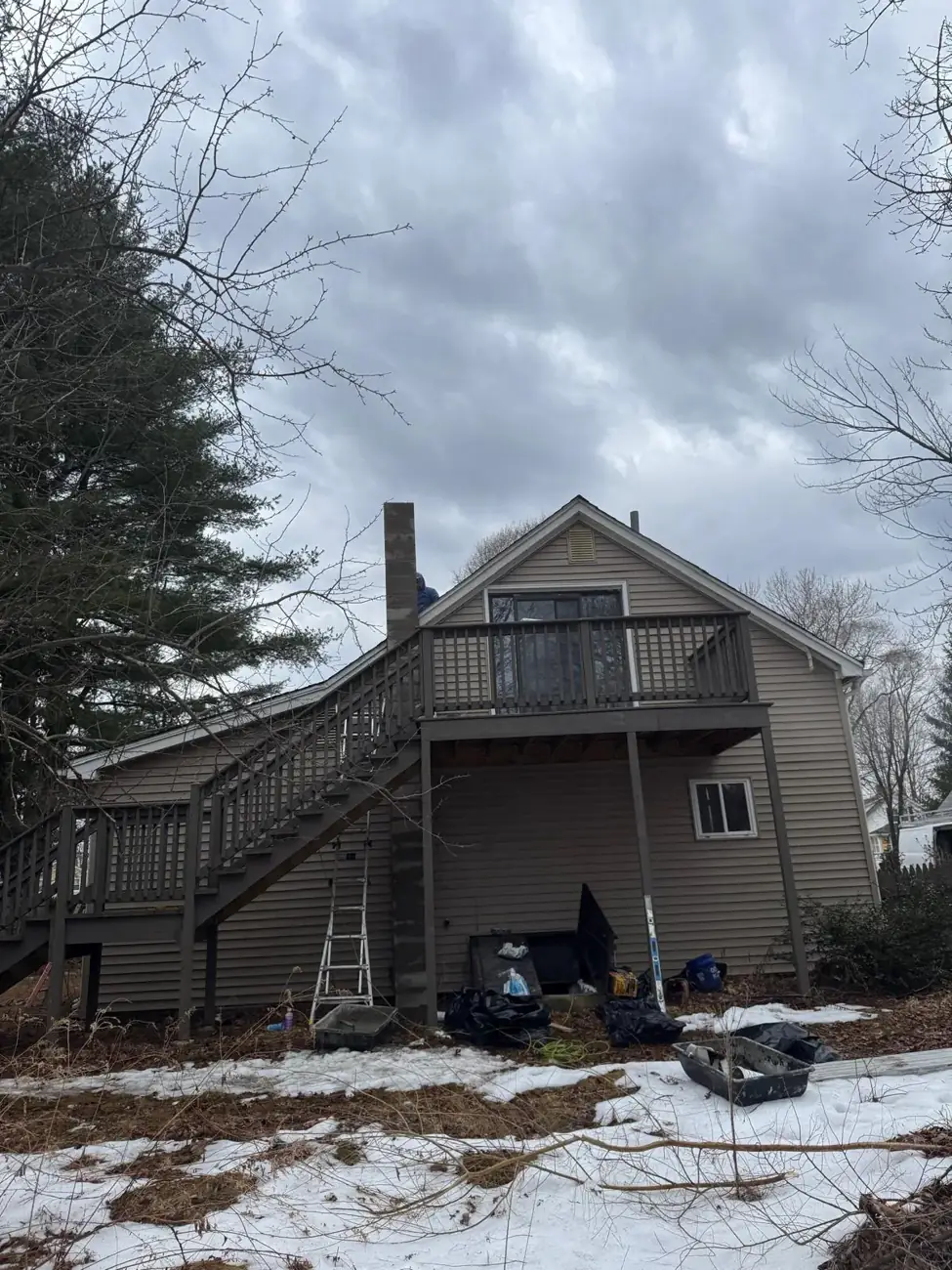
Brick and mortar are porous. A chimney standing above the roof catches rain on every side, and in a nor’easter that rain is driven sideways into the masonry for hours. The brick absorbs it slowly, like a sponge, and gives it back slowly too.
In Connecticut, absorbed water does its real damage in winter. It freezes inside the brick and mortar, expands, and pushes the surface apart; then it thaws, soaks a little deeper, and freezes again. Over a few winters, brick faces flake off, which is called spalling, mortar joints erode, and water starts finding its way into the attic and ceilings.
Age plays a part. Many pre-war colonials and Victorians have softer brick than modern houses, laid in soft lime mortar. That older brick tends to absorb more water, so it benefits most from protection, but it is also the brick most easily harmed by the wrong coating.
What waterproofing protects, and what it does not
A repellent is one layer of defense. It helps to know exactly which part of the chimney it covers.
Brick faces: protected
This is the main target. Less water absorbed means less water left to freeze and break the surface.
Mortar joints: only if sound
Tight joints are protected along with the brick. Open joints are not, because water runs into the gap instead of through the pores.
The crown: separate job
The concrete cap on top has its own repair and sealing methods. A brick repellent is not a substitute for a sound crown.
Flashing: separate system
Metal flashing and its seal to the brick are what keep water out at the roofline. Treating the brick does nothing for a flashing leak.
Inside the flue: a liner question
Moisture from oil or gas exhaust condensing inside an old flue attacks the brick from within. That calls for the right liner; see liner costs.
Leak locator
Pick where the water shows up to see the likely sources.
Breathable repellent vs. coatings that trap water
The product matters as much as the application. A chimney has moisture moving through it from both sides, so it needs a treatment that keeps liquid water out without sealing water vapor in.
| Question | Vapor-permeable water repellent | Paint or film-forming sealer |
|---|---|---|
| How it works | Soaks into the pores and repels liquid water | Forms a skin over the surface of the brick |
| Moisture already inside | Can still escape as vapor | Gets trapped behind the film |
| Appearance | Usually little visible change to the brick | Often glossy or darker; can peel and flake |
| In a Connecticut winter | Brick stays drier, so freeze–thaw damage slows | Trapped water freezes behind the film and can pop brick faces off |
Fix these before waterproofing, or the money is wasted
A repellent protects the face of the brick. It does not close a crack or seal a gap, so these come first:
- A cracked or crumbling crown, which lets water straight down into the chimney. See crown repair.
- Flashing that has pulled away where the chimney meets the roof. See flashing and leak repair.
- A missing or rusted-through cap that lets rain fall into the flue.
- Open, sandy or eroded mortar joints that need repointing.
- Spalled or cracked bricks that need to be replaced.
- Any old paint or film-forming sealer on the brick. A breathable product needs bare masonry to soak into, so that has to be dealt with first.
Is waterproofing worth it on your chimney?
It is a good fit when the masonry is in decent shape and you want to keep it that way: a newly repointed or rebuilt chimney, a chimney exposed to wind-driven rain on a hilltop or near the shore, or older brick that darkens and stays wet for a day after every storm.
It is a poor fit when the chimney is already leaking from the crown or flashing, when bricks are loose, or when the brick has a coating on it. In those cases the repellent belongs on the list after the repairs, not instead of them. If water is already showing up inside the house, start with why a chimney leaks.
Here is a check you can do from the yard. The afternoon after a good rain, look at the chimney with binoculars. Patches of brick that stay darker than the rest, white streaks of efflorescence, or rust streaks below the cap all point to water moving through the masonry. Stay on the ground; everything you need to see is visible from there.
How A Class waterproofs a chimney
The order of the work matters more than the brand of repellent.
- Look before sealingAfter you call or request a callback, a $59 on-site visit checks the crown, cap, flashing and mortar, with drone photos of the top so you see exactly what the tech sees.
- Repairs first, priced separatelyAnything that needs fixing before the repellent goes on is its own line on the written price, so you can see where each dollar goes.
- Clean, dry masonryThe repellent goes on clean, dry brick in suitable weather: not straight after a storm, and not in freezing temperatures.
- Full coverageThe product is applied evenly to the exposed brick and mortar above the roof, working carefully around the flashing and roofing.
- Checked at your next inspectionAt your yearly visit, the tech can see whether water still beads on the brick and tell you when it is time to reapply.
What it costs and how long it lasts
Waterproofing a typical chimney runs about $300–$800 as a ballpark. Height, how many sides are exposed above the roof, and how much cleaning the brick needs first move the price within that range. You get the exact figure in writing after the $59 on-site inspection, along with any repairs that should come before it.
How long a repellent lasts depends on the product and on how much weather the chimney takes. A chimney on an exposed ridge or facing the prevailing storms wears the treatment faster than one sheltered by the house. Rather than going by the calendar, have the beading checked during your annual cleaning and inspection.
Along the shoreline, wind-driven rain carries salt into the brick. As the brick dries, the salt crystallizes in the pores and wears the surface faster, and it rusts lower-grade metal caps. A breathable repellent and a stainless cap are worth more on a chimney that faces the Sound.
Prefer we call you?
Three quick taps and a real person from A Class Chimney calls you back to set up a $59 on-site inspection.
- $59 on-site visit and written estimate
- Photos of everything we find
- A written price before any work starts
- Licensed and insured in Connecticut
Sunday to Friday
What do you need?
When?
Where should we call you?
Free, no obligation. Privacy
Common questions
Related guides and services
Have us take a look
$59 on-site visit, photos of what we find and a written price before any work. Licensed and insured in Connecticut.