
White Stains on Your Chimney: Efflorescence Explained
That chalky white bloom on your chimney is salt left behind by water moving through the brick. It is harmless in itself, but it shows you exactly where water is getting in.
Sunday to Friday
White powdery stains on chimney brick are usually efflorescence: salts dissolved by water inside the masonry and left on the surface when that water evaporates. The stain does little harm by itself, but it means water is moving through the chimney, which leads to spalling and mortar damage in Connecticut’s freeze–thaw winters. Brush it off dry, then find and fix the water source.
What efflorescence actually is
Brick, mortar and concrete all contain small amounts of soluble salts. When water soaks into the masonry, it dissolves those salts and carries them along. As the water reaches the surface and evaporates, the salts stay behind as a white, powdery or slightly fuzzy crust.
That makes the white stain a map of where water has traveled. A chimney with no water moving through it doesn’t keep producing new efflorescence. When the stains return after you clean them, the masonry is still getting wet from somewhere.
It tends to show up most in late fall, winter and early spring, when the masonry gets soaked and then dries slowly in cool, damp air. A hot, dry summer can hide it, which is why a chimney can look clean when you buy a house in July and turn white by the following April.
There is one normal exception. New brickwork, including a freshly rebuilt chimney top, can bloom white in its first season as construction moisture dries out. That kind usually fades as the masonry dries and doesn’t keep coming back.
Where the stain sits tells you where the water comes from
Efflorescence shows up where water exits the masonry, which is often below or downhill from where it got in. Use the location as your first clue.
| Where you see white | Likely water source | Usual fix |
|---|---|---|
| Just below the top, on all sides | A cracked crown, a crown with no overhang, or an uncapped flue | Crown repair and a chimney cap |
| Mostly on one face | Wind-driven rain soaking the side that faces the weather | Repointing failed joints, then a breathable water repellent |
| Around the roofline | Flashing that has pulled away or was never properly set into the brick | Flashing repair or replacement |
| On the chimney in the attic | Water running down inside the chimney from the top or the flashing | Fixing the crown, cap or flashing |
| On the fireplace face or the chimney in the basement | Water traveling down the full height of the chimney, or ground moisture at the base | Finding the entry point first, which may be far above the stain |
| Near the top of an oil or gas flue | Acidic condensation from an unlined or oversized flue | A flue inspection; relining is often the answer |
Leak locator
Pick where the water shows up to see the likely sources.
Is it efflorescence, or something else?
A few other things leave white or pale marks on a chimney. A quick look and a damp cloth usually tell them apart.
Efflorescence
Soft, powdery or fuzzy. It brushes off easily when dry and dissolves if you dab it with water, then reappears when the masonry gets wet again.
Lime run
Hard, crusty white streaks, often dripping down from a mortar joint or the crown. Water won’t dissolve it and a brush won’t move it. It means water has been washing through the mortar for a long time.
Mold or mildew
Usually green, gray or black rather than bright white, and most common on a shaded face. It smears when wiped instead of brushing away as dry powder.
Paint or an old coating
A white film that flakes and peels in patches. Some older chimneys were painted or coated, and the film lets go as moisture builds up behind it.
Why it matters in a Connecticut winter
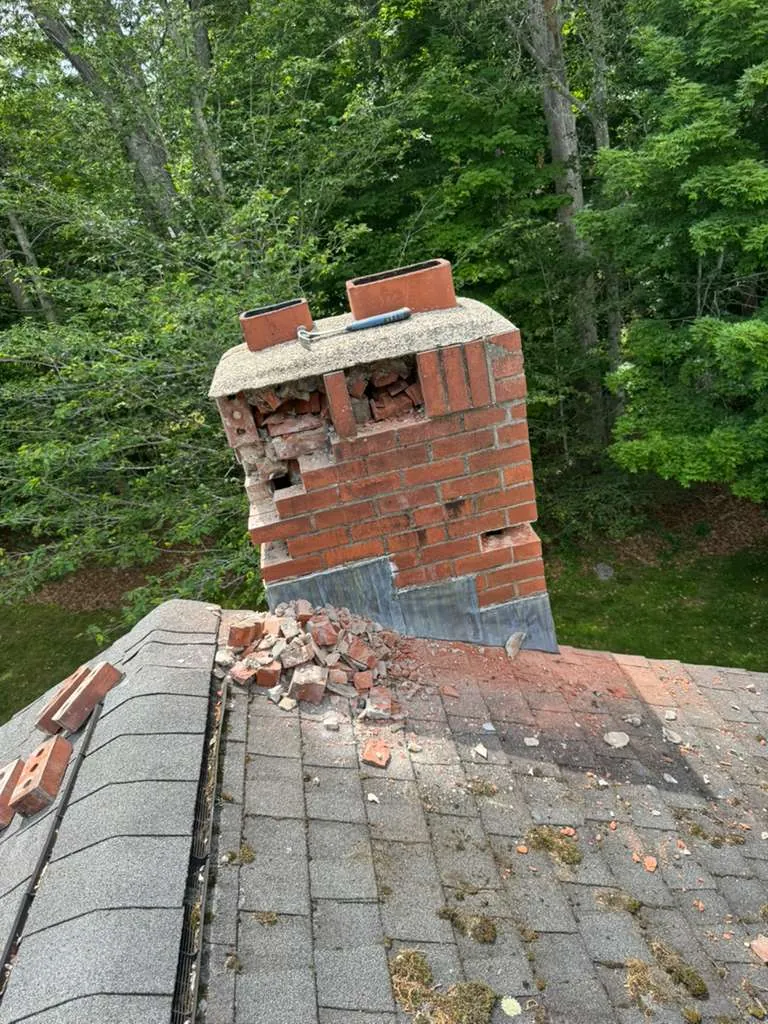
Here, a wet chimney is a vulnerable chimney. Water inside brick and mortar freezes on cold nights and expands, then thaws, and that cycle repeats many times between November and March. Each round pries the masonry apart a little more, until brick faces pop off and mortar crumbles out of the joints.
Salts add to the damage. When they crystallize just under the surface of the brick instead of on top of it, they can push the face of the brick off from the inside, a process called subflorescence. If you see efflorescence along with flaking or crumbling brick, the chimney is past the cosmetic stage, and our page on spalling brick repair explains what comes next.
Homes near the shoreline deal with salt air on top of wind-driven rain, which adds to the salt load in the masonry and keeps it damp longer after storms.
How to clean efflorescence safely
Only clean the parts of the chimney you can reach from the ground, the attic or the basement. Never climb onto the roof to do it.
- Wait for a dry spellClean after the masonry has been dry for a few days. Wetting it while you clean dissolves more salt and draws it back to the surface.
- Brush, don’t scrapeUse a stiff natural-bristle or nylon brush and remove the powder dry. Skip wire brushes, which scratch brick and can leave steel particles that rust.
- Collect the powderSweep or vacuum it up so the next rain doesn’t wash it back into the masonry.
- Leave the strong methods to a proDon’t pressure-wash, which drives water deep into soft old brick and can blast out mortar, and don’t use acid cleaners yourself; they can burn mortar and stain the brick.
- Watch for it to come backIf the white returns after the next few rains, the water source is still active and needs fixing.
Stopping it: fix the water, then protect the brick
The lasting fix is always the water source. Depending on what the inspection finds, that may be a crown repair at about $200–$1,200, a stainless cap at about $150–$600, flashing repair at about $400–$1,500, or repointing failed mortar joints at about $800–$3,000+. These are Connecticut ballpark figures, and the firm price comes in writing after a $59 inspection visit to look at the chimney.
Once the leaks are fixed and the masonry has dried, a vapor-permeable water repellent helps the brick shed rain while letting moisture inside escape, at about $300–$800 as a ballpark. Avoid paint, film-forming sealers or anything else that traps moisture, because they hold water and salts in and make spalling worse. Our page on chimney waterproofing explains the difference.
How A Class reads the stains on your chimney
Efflorescence is one of the most useful clues a chimney gives, and we treat it as one.
- Start with a callCall (203) 779-6787 or request a callback, and tell us where the white shows up: outside, inside or both.
- $59 inspection visitWe look at the crown, cap, flashing and mortar, check the attic and basement sides when you can give us access, and run a camera up the flue if the stains point inside.
- Photos that connect the dotsWe photograph the stains and the places water gets in, including drone photos of the crown, so you can see how one leads to the other.
- Written priceThe fix comes as a written price, with the repair and any waterproofing listed separately, before any work starts.
- Tidy workThe crew protects the roof and the areas below, makes the repairs and cleans up afterward.
Prefer we call you?
Three quick taps and a real person from A Class Chimney calls you back to set up a $59 on-site inspection.
- $59 on-site visit and written estimate
- Photos of everything we find
- A written price before any work starts
- Licensed and insured in Connecticut
Sunday to Friday
What do you need?
When?
Where should we call you?
Free, no obligation. Privacy
Common questions
Have us take a look
$59 on-site visit, photos of what we find and a written price before any work. Licensed and insured in Connecticut.