
Asphalt Shingle Roofing in CT: 3-Tab vs Architectural
Asphalt shingles cover most Connecticut homes for good reason. Here is how to choose the type, what has to go underneath, and what separates a roof that lasts from one that doesn’t.
Sunday to Friday
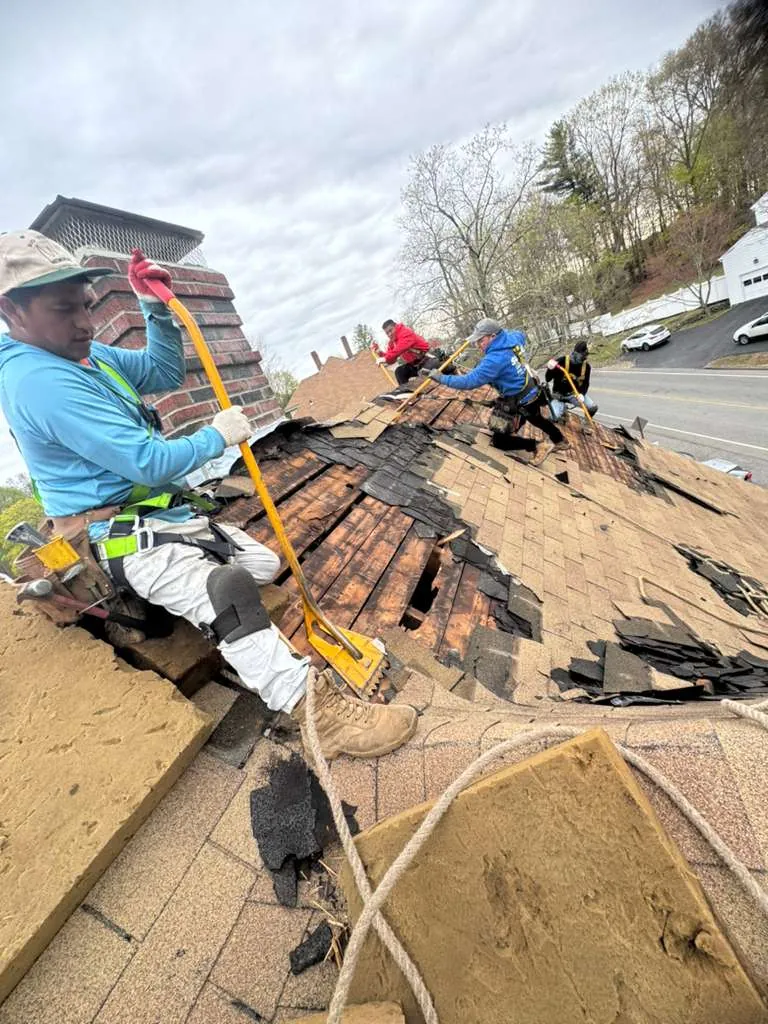
On the typical Connecticut colonial, cape or ranch, architectural (dimensional) shingles make more sense than 3-tab: they typically last 20–30 years, hold up to wind better, and cost only modestly more. A full replacement on a typical CT home runs about $10,000–$25,000+ as a ballpark, and the parts you never see, such as the ice barrier, flashing and ventilation, decide how long it really lasts.
3-tab or architectural shingles?
Both are asphalt shingles topped with mineral granules, but they are built differently, and the difference shows up in wind resistance, appearance and lifespan.
| Feature | 3-tab | Architectural |
|---|---|---|
| Construction | A single layer cut into three even tabs | Two or more laminated layers cut in irregular shapes |
| Typical lifespan in Connecticut | 15–20 years | 20–30 years |
| Appearance | Flat, uniform rows | Thicker, shadowed look that suggests wood shake |
| Wind | Light tabs lift more easily in strong gusts | Heavier, and generally rated for higher winds |
| Uneven roof deck | Shows every dip and wave | The random pattern hides minor unevenness |
| Where it fits best | Sheds, garages, or matching an existing 3-tab section | Most houses being reroofed today |
What a complete shingle roof includes
Shingles are only the top layer of a system. When two quotes are far apart, the gap is usually hiding in these parts.
Ice and water membrane
A self-sealing membrane along the eaves, required by cold-climate codes, that keeps water backed up behind ice dams away from the deck. Good installers also run it through valleys and around chimneys and skylights.
Underlayment
A synthetic or felt layer over the rest of the deck. It is the second line of defense when wind-driven rain gets under a shingle during a nor’easter.
Drip edge and starter course
Metal drip edge steers water into the gutter instead of behind the fascia, and a starter strip seals down the first row so wind cannot peel it back from the edge.
Flashing
Step flashing along walls and dormers, plus new boots on plumbing vents. Old flashing reused under new shingles is a common source of early leaks. Chimney flashing is a specialty of its own; see chimney flashing repair.
Ventilation
Intake at the soffits and exhaust at the ridge keep the attic dry in winter and cooler in summer. Poor attic ventilation bakes shingles from below and feeds ice dams.
Hip and ridge cap
Purpose-made cap shingles finish the peaks and hips. They take more wind than any other part of the roof, so cut-up 3-tab pieces are a poor substitute.
Repair or replace?
Five quick questions for a rule-of-thumb answer.
Repair a shingle roof, or replace it?
A few torn or missing tabs, a cracked pipe boot or a short flashing leak is a repair job, usually $350–$1,500 as a ballpark. Replacement starts to make sense when the problems are spread across the roof rather than sitting in one spot.
Signs the shingles themselves are worn out: granules piling up in gutters and at downspout outlets, bald patches, edges curling up or corners cupping, cracks across many tabs, and shingles that have lost their seal and flap in wind. Age matters too. A 3-tab roof approaching 18 or 20 years, or an architectural roof in its mid-twenties, is usually near the point where repairs stop being good value.
Sometimes one slope wears out first, usually the south or west face that takes the most sun. Replacing only that slope can make sense when the other faces are still sound, though new shingles will not match weathered ones exactly and the joint at the ridge needs careful work.
If you are weighing that choice right now, our guide to repairing or replacing a roof walks through it step by step.
Connecticut details that matter on a shingle roof
Tear-off or a second layer. Building codes generally allow no more than two layers of asphalt shingles, but laying new over old hides rotted decking, adds weight and gives the new shingles a lumpy base. On most reroofs, stripping to the deck is the better job. Permit rules for reroofing vary by town, and the local building department can tell you what applies on your street.
Ice dams. Heavy, wet snow on a roof over a warm attic melts from below and refreezes at the cold eaves. The ice barrier limits the damage, but the cause is heat escaping from the house, which is why insulation, air sealing and ventilation belong in the conversation. Our ice dam guide goes deeper.
Algae and shade. Black streaks on north-facing slopes under big oaks and maples are usually algae, not dirt or failing shingles. Many shingles are now made with algae-resistant granules, which is worth asking about if your house sits in shade.
Wind. Nor’easters and hurricane remnants test the seal strip on every shingle. Correct nailing, in the right zone of the shingle and with the right number of nails, matters as much as the wind rating printed on the bundle.
Older decking. Many older colonials and capes were built with board sheathing rather than plywood. Wide gaps between dried-out boards, or boards softened by old leaks, sometimes call for new plywood or OSB during tear-off, which is one reason decking repairs are priced separately from the shingles.
Ballpark cost of asphalt shingle work in Connecticut
Where your roof lands within these ranges depends on its size and pitch, how many layers come off, how much decking needs replacing, the number of valleys, dormers, skylights and chimneys to flash, and whether ventilation is being improved at the same time. Steep roofs on tall colonials and Victorians cost more to work on safely than a low ranch.
All three figures are 2026 ballparks, and your own number arrives in writing once the roof has been looked at in person, at no charge. For a longer breakdown, see roof replacement cost in Connecticut.
- Minor shingle repair (torn tabs, a pipe boot, a small flashing fix): $350–$1,500
- Larger repair (a decking section, a valley, several areas): $1,500–$4,000
- Full asphalt shingle replacement, typical Connecticut home: $10,000–$25,000+
Questions to ask when comparing shingle roof quotes
Line the quotes up side by side and get an answer to each of these. Vague answers are a warning sign in their own right.
- Is it a full tear-off, or new shingles over an existing layer?
- Which shingle line is being used, and is it 3-tab or architectural?
- How far up from the eaves does the ice and water membrane run, and does it go in the valleys?
- Is all flashing new, including step flashing and pipe boots, or is some being reused?
- How will rotted decking be handled and priced if it turns up during tear-off?
- What is being done about attic intake and exhaust ventilation?
- Is drip edge included on both the eaves and the rakes?
- How will the yard, plantings and driveway be protected, and how is cleanup done?
How A Class plans a shingle roof with you
- Start with a conversationWhen you phone (203) 779-6787 or send a callback request, mention roughly how old the roof is and what made you start thinking about replacing it.
- A look at the whole roofWe check the shingles, decking, flashing, vents and attic, and take drone and on-roof photos so you can see exactly what we saw.
- Everything named on paperYour written price names the shingle type, the underlayment and ice barrier, the flashing and the ventilation, so it can be compared line by line with any other quote.
- Installation and a clean siteThe crew tarps plantings and the sides of the house, strips and installs the roof, and cleans up the property. Our page on what to expect during a new roof installation walks through the days.
Prefer we call you?
Three quick taps and a real person from A Class Chimney calls you back to set up a free roof inspection.
- Free roof inspection and written estimate
- Photos of everything we find
- A written price before any work starts
- Licensed and insured in Connecticut
Sunday to Friday
What do you need?
When?
Where should we call you?
Free, no obligation. Privacy
Common roofing questions
Have us look at your roof
Free roof inspection, photos of what we find and a written price before any work. Licensed and insured in Connecticut.