
Leaning or Separating Chimney Repair in CT
A gap between the chimney and the wall rarely closes on its own. Here is how to judge how serious it is, what usually causes it, and what the repair options look like.
Sunday to Friday
A chimney leans or separates from the house when its footing settles, when water and frost damage the masonry, or when mortar in the top section fails. A lean only above the roofline is usually fixed with a partial rebuild; a whole chimney pulling away points to a footing problem that needs a structural assessment first. Either way, stop using it until it has been inspected.
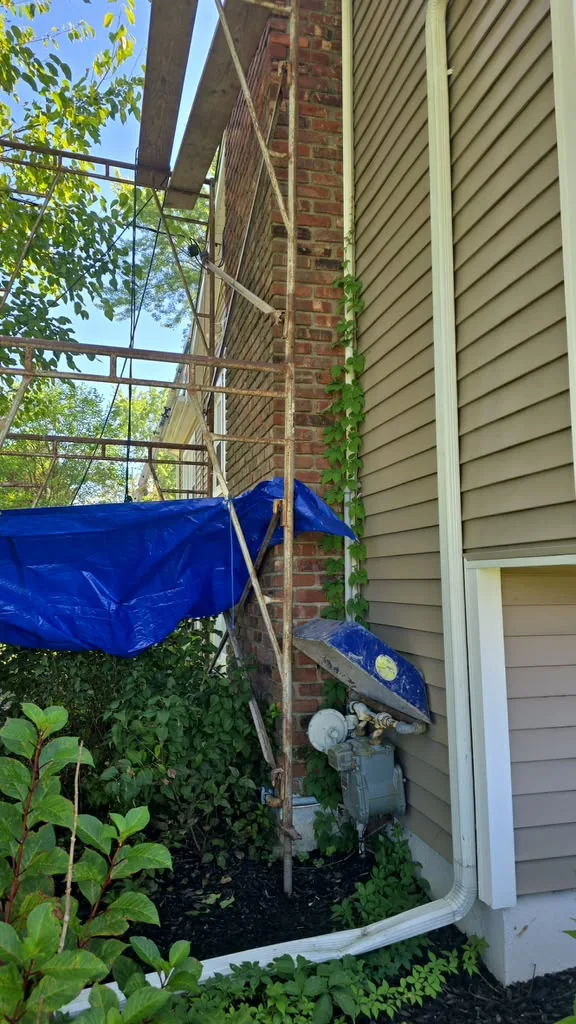
Two different problems that look alike
When people say their chimney is leaning, they usually mean one of two things, and the repairs are very different.
The whole chimney is tipping away from the house. A gap opens between the chimney and the siding, often wider at the top than at the bottom. This is almost always about what the chimney stands on: the footing has settled or shifted, and the heavy masonry is slowly rotating away from the wall.
Only the top is leaning. The chimney is tight to the house, but the section above the roof has a visible bend or tilt. That points to the masonry itself: mortar joints on one side have broken down or swelled, and the top has shifted on the courses below it.
In Connecticut the first problem shows up most often on exterior chimneys, the ones built against an outside wall of a cape, ranch or colonial, sometimes on a footing poured separately from the house foundation. Interior chimneys that rise through the middle of the house have the structure all around them, so the whole stack rarely tips, but the part above the roof can still bend.
What makes a chimney lean or pull away
A small or shallow footing
Many older chimneys, especially exterior chimneys added to a house later, sit on a footing that is undersized or may not reach below the frost line. Over decades, the ground under it settles or heaves.
Water at the base
Downspouts that empty right beside the chimney soften the soil under the footing, and grading that slopes toward the house does the same thing more slowly.
Frost heave
Connecticut winters freeze and thaw wet soil again and again. A footing that isn’t deep enough moves a little each winter and never quite settles back.
Mortar failure up top
Water, freeze–thaw and, in chimneys that vented oil or gas without a proper liner, acidic condensation can break down or swell mortar joints unevenly, so the top bends toward one side.
Roots and nearby digging
Large tree roots close to the footing, or excavation for an addition or patio, can undermine the soil the chimney rests on.
Rotted framing in a chase
Factory-built chimneys sit inside a wood-framed chase. If a leaking chase cover has rotted that framing, the whole chase can tilt; see prefab chimney repair.
Chimney symptom checker
Tick what you have noticed and see what it usually means.
How to judge how serious it is
You can learn a lot from the ground and from inside the house. Write down what you find; the trend over a few weeks matters more than any single measurement.
- Measure the gap between the chimney and the siding at the widest point you can reach from the ground, and photograph it with the tape in the shot
- Mark both ends of a crack with a pencil and the date, so you can see whether it grows
- Look for diagonal, stair-step cracks running through the mortar on the sides of the chimney
- Check whether the gap is wider at the top than at the bottom, a sign the chimney is rotating on its footing
- Look inside for cracks in the wall or ceiling beside the chimney, a hearth separating from the floor, or a mantel pulling off the wall
- Look at the flashing where the chimney meets the roof; movement often tears it and starts a leak
- Note any loose or missing bricks near the top or around the roofline
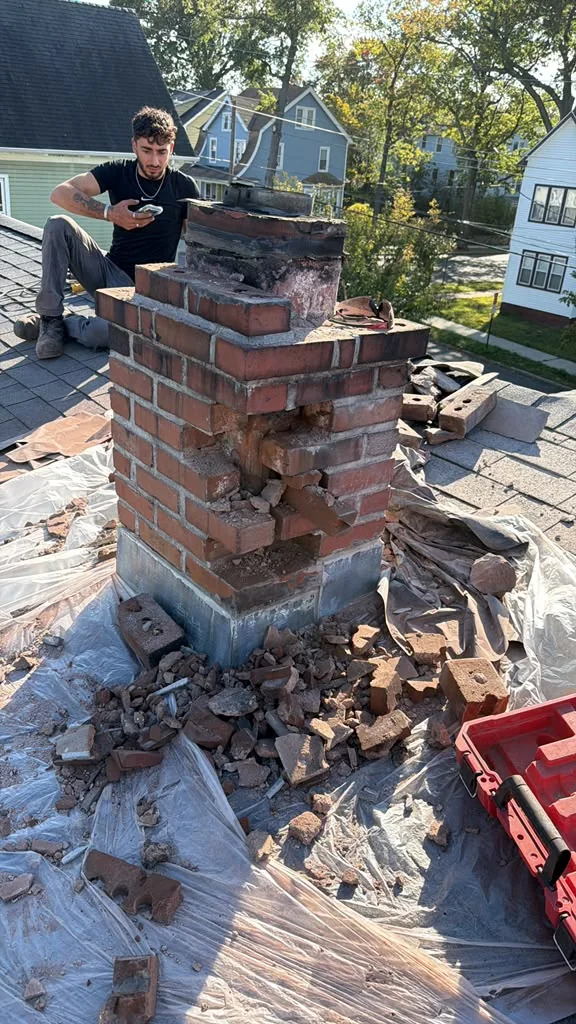
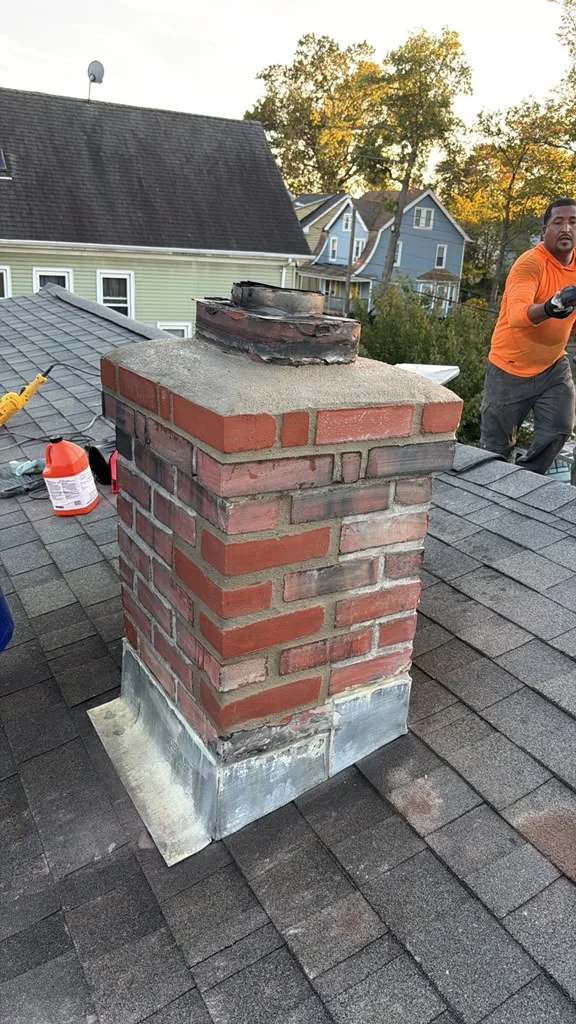
A real partial rebuild, before and after
The same chimney, during and after the work. The damaged top courses come down with the roof covered in tarps, then the top is rebuilt and finished with a new crown.
If the gap grows noticeably over days rather than months, bricks are falling, or the chimney moved after a storm, keep people and cars away from the side it leans toward and don’t use the fireplace or any appliance that vents into it. Our page on emergency chimney repair covers the first steps.
What a moving chimney does to the flue
Movement outside usually means damage inside. As the chimney shifts, clay flue tiles crack and their joints open, and the connection between the fireplace and the flue can separate. Those gaps can let smoke, heat and carbon monoxide reach the framing and the living space.
That is why a chimney that has moved should have a camera inspection of the flue before it is used again. NFPA 211 recommends a Level 2 inspection after any event that may have damaged the chimney, and a Level 2 runs about $250–$500 as a ballpark. If the flue is cracked but the structure is stable, relining with stainless steel, about $1,500–$4,000+, is often the repair.
Repair options, and why the order matters
For a top-only lean, the usual fix is to take the chimney down to sound masonry, often near the roofline, and rebuild it plumb with new mortar, a new crown and new flashing. That is a partial rebuild, about $3,000–$8,000 as a ballpark, and our page on chimney rebuild costs explains what moves the price. Every ballpark becomes a written price after the $59 on-site inspection.
When the whole chimney is rotating away from the house, the problem starts below ground. A structural engineer’s opinion is worth getting before anyone rebuilds above it, because rebuilding on a footing that is still moving only repeats the failure. Footing and foundation work is done by a foundation contractor; once the base is stable, the masonry above can be repaired or rebuilt.
Sometimes the chimney is too far gone to repair in sections, and a full rebuild, about $8,000–$20,000+ as a ballpark, makes more sense once the base is sound. If the chimney isn’t needed anymore, taking it down may be worth pricing too.
What to expect when A Class looks at a leaning chimney
Leaning chimneys get a careful look, because the right answer depends on where the movement starts.
- Your callPhone us at (203) 779-6787 or use the callback form, and tell us how wide the gap is, whether it seems to be growing, and what vents into the chimney.
- $59 on-site inspection with a levelWe check plumb with a level, look at the base, the roofline and the top, and inspect the flue with a camera if the chimney is still in use.
- Photos and measurementsYou get photos of the gap, the cracks, the flashing and the top, with drone shots when the roof is steep.
- A straight answer in writingIf the lean is at the top, you get a written price for the rebuild. If the footing is moving, we tell you an engineer and a foundation contractor need to come first, and price our part for afterward.
- Rebuild and clean-upOnce the base is sound and you approve, the crew rebuilds, reflashes the chimney and cleans up.
Prefer we call you?
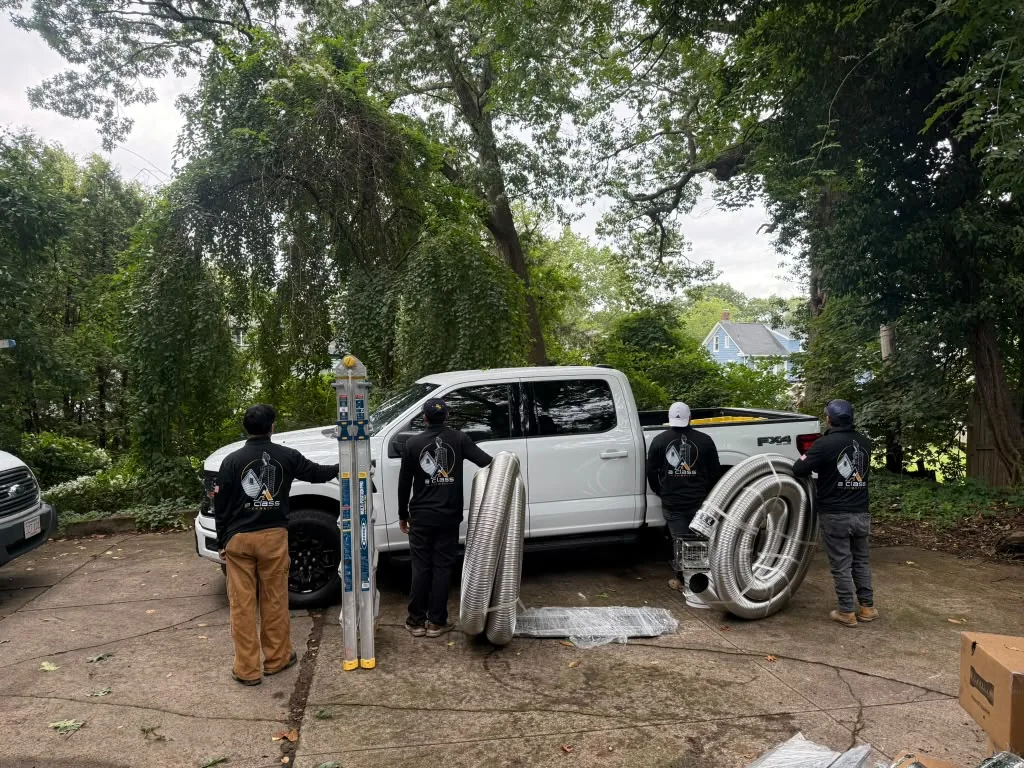
Three quick taps and a real person from A Class Chimney calls you back to set up a $59 on-site inspection.
- $59 on-site visit and written estimate
- Photos of everything we find
- A written price before any work starts
- Licensed and insured in Connecticut
Sunday to Friday
What do you need?
When?
Where should we call you?
Free, no obligation. Privacy
Common questions
Have us take a look
$59 on-site visit, photos of what we find and a written price before any work. Licensed and insured in Connecticut.